1 Scheme Requirements
1.1 Mobility Adaptability
Mobile digital seismic observation equipment shall first satisfy mobility requirements. All components of the mobile digital seismic observation system shall feature small size, light weight, low power consumption, high reliability, easy installation and maintenance, and capability to operate under harsh working environments.
1.2 Requirements for Improved Data Quality
Compared with analog recording systems, digital observation systems have distinct advantages in improving observation data quality, including wide frequency bandwidth, large dynamic range, good linearity, low distortion of digital records, and complete waveform recording of seismic events.
1.3 Adaptability to Diverse Network Objectives and Deployment Scales
Apart from temporary on-site seismic observation, the mobile digital seismic observation system can also be deployed in fixed areas to record microearthquakes and ultra-microearthquakes, functioning as local seismic stations. Typical deployment scenarios are listed below: A. Deployed in seismically active and earthquake-prone regions; B. Deployed in economically developed large and medium-sized cities as well as coastal open cities; C. Deployed around major projects such as large reservoirs, mines and nuclear power plants to record background seismic activity and provide basic data for the safety of large-scale facilities.
1.4 Requirements for Large-Capacity Data Storage
2 Composition of Mobile Digital Seismic Observation System
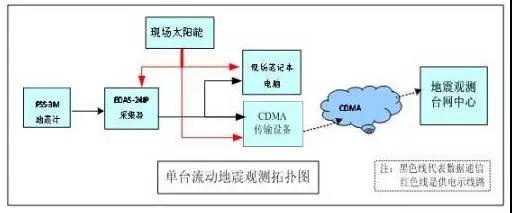
Considering the characteristics of mobile digital seismic observation, our company recommends a mobile seismic station consisting of the FSS-3M short-period seismometer, EDAS-24IP/GN series seismic data acquisition unit, laptop computer, single-station seismic data processing software, wireless CDMA transmission module and solar battery. The block diagram is shown as follows:
In recent years, integrated, compact and portable short-period seismometers and broadband seismometers have been successfully developed. They enable more convenient and highly integrated real-time data transmission and support on-site seismic data analysis and processing.
The system can also be connected to a wireless CDMA router via data cables. The CDMA router interconnects with the seismic network center through a VPN tunnel to transmit data to a seismic data processing server with a fixed IP address installed with our dedicated analysis and processing software for data analysis.
This mobile configuration scheme is widely adopted for emergency mobile observation.