As we all know, ground vibration constitutes a key factor affecting the service life of historic buildings and heritage sites. Therefore, vibration monitoring for historic buildings and heritage sites serves as a routine conservation measure, and is also the first link in the conservation cycle of “Monitoring – Inspection – Diagnosis – Maintenance”. Monitoring at heritage sites is generally carried out in three aspects:
1 Monitoring of Vibration Sources near Heritage Sites
For heritage conservation, it is first necessary to identify all nearby vibration sources, which are classified into regular and irregular sources. Regular vibration sources refer to well-defined daily vibration origins such as metro lines and expressways. Irregular sources include natural earthquakes, mine earthquakes and artificial blasting. In general, the locations and active time windows of regular sources are relatively clear, while irregular sources must be identified via seismic observation.
According to seismological principles, to monitor vibration source information near heritage sites, no less than two seismometers (velocity sensors) shall be installed on bedrock or in boreholes adjacent to the site. Intersection location techniques can then be adopted to accurately determine the locations and occurrence patterns of nearby natural and artificial seismic sources.
At present, with two BBVS seismometers deployed, the location accuracy for monitoring earthquakes of magnitude ML3–4 within a 300 km radius of the heritage site reaches approximately 1 km. For instance, seismic data recorded by the seismic station at the Longmen Grottoes for the Fan County Earthquake in Henan on August 15, 2014 indicates a doublet earthquake (see Figure 1). The first event: ML3.4 Fan County Earthquake on August 15, 2014, epicenter (35.70°N, 115.42°E), focal depth H=6 km, origin time (2014-08-05 17:25:22.8). The second event: ML2.2 earthquake, epicenter (35.71°N, 115.43°E), focal depth H=8 km, origin time (2014-08-05 17:24:09.6). Both events are natural earthquakes, with epicentral distances of 293 km and 294 km respectively to the Longmen Grottoes seismic station.
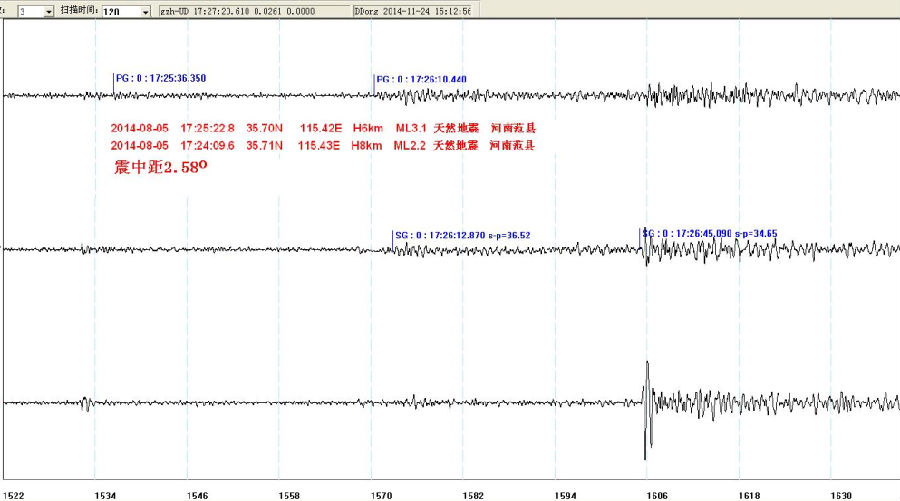
Figure 1 Waveform Analysis of the Fan County Earthquake, Henan Province on August 15, 2014
The Longmen Grottoes seismic station is located at 34.70°N, 112.44°E. It is equipped with FSS-3M short-period seismometers and operated continuously from 2013-11-16 to 2014-10-18, representing a successful seismic observation campaign. Through 11 consecutive months of continuous recording, seismic source information within 300 km of the heritage site was successfully captured.
Continuous monitoring and timely analysis & summarization of measured results are required to effectively track vibration sources near heritage sites.
2 Site Ground Motion Intensity Monitoring
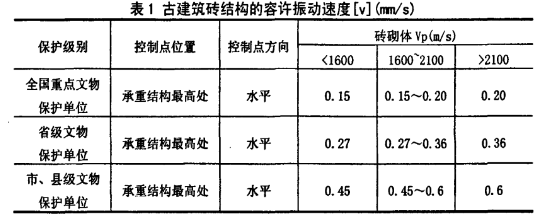
Nevertheless, seismometers (velocity sensors) alone cannot satisfy the requirement of ground motion intensity monitoring at the heritage site, i.e., they cannot quantify the vibration intensity induced by nearby earthquakes and regular vibration sources acting on historic buildings and heritage sites. In accordance with the Technical Specifications for Protection of Historic Buildings against Man-made Vibration, horizontal Peak Ground Velocity (PGV) is adopted as the evaluation indicator for vibrations affecting historic buildings (see Table 1).
3 Heritage Health Monitoring
After years of weathering and erosion, historic buildings and heritage sites have degraded structural integrity. When subjected to strong nearby vibration sources or moderate-to-large distant earthquakes, such ancient structures may suffer structural damage or even catastrophic collapse, resulting in the loss of precious cultural relics. Structural vibration monitoring is the most widely adopted and effective method for timely detection of internal structural damage.
Structural Health Monitoring (SHM) refers to damage detection and identification for engineering structures. Dating back to the early 19th century, railway workers tapped rails with small hammers and judged defects from acoustic feedback. Damage discussed herein covers changes in material properties, geometric characteristics of structural systems, boundary conditions and system continuity. The global continuity of a system plays a decisive role in the service capacity of the structure. Structural Health Monitoring involves analyzing dynamic response data periodically collected from sensor arrays deployed on structures to track temporal variations of the system, extract damage-sensitive characteristic parameters, and assess structural health conditions through data analysis. For long-term SHM, regularly updated data is used to evaluate whether structures can continuously fulfill their design functions under aging and harsh service environments.
An SHM system integrates knowledge across multiple disciplines including modern sensor technology, signal testing, analysis & processing, data communication, as well as structural analysis and prediction theories, developed based on extensive field practices. It can measure, store and analyze various status information of bridges and building structures during operation. The system enables continuous, real-time, online monitoring and assessment of structural health, delivers instantaneous and accurate evaluation of structural safety, greatly expands the scope of conventional manual inspection, facilitates predictive maintenance, improves operation & maintenance management, guarantees the reliability, safety and durability of large heritage sites and buildings, and prevents potential catastrophic failures.
Accelerometers remain the simplest and most effective tool for building monitoring. With support from Crossbow Technology, the University of California, Berkeley deployed a structural health monitoring system on the Golden Gate Bridge in San Francisco. The system was originally designed to measure vibration at critical load-bearing points of the bridge under wind loads. After establishing an overall numerical model from recorded data, severely aged and damaged zones of the bridge can be identified for targeted repair. Data collected routinely by the system can also track building aging and provide auxiliary decision-making information for maintenance.
A core research focus in SHM lies in distinguishing damaged structures from intact ones using data features. Measured vibration spectra or natural frequencies from field tests are among the most commonly adopted indicators.
3.1 Damage Detection Axioms
After 20 years of development, this discipline has reached a mature stage with well-established fundamental theories and principles [5], listed as follows:
Axiom 1: All materials contain inherent flaws.
Axiom 2: Damage assessment requires comparison between two states of the system.
Axiom 3: The existence and location of damage can be determined via reference-free analysis; however, identification of damage type and severity demands reference-based comparative research.
Axiom 4a: Sensors cannot directly measure damage. Feature extraction and statistical classification via data processing are required to convert raw sensor data into damage information.
Axiom 4b: In the absence of intelligent feature extraction algorithms, the higher the test sensitivity to damage, the greater the influence of operational and environmental factors on measurement results.
Axiom 5: The length and time scales associated with damage initiation and evolution determine the characteristic parameters required by SHM sensor systems.
Axiom 6: There exists a trade-off between algorithmic sensitivity to damage and noise immunity.
Axiom 7: The detectable damage size derived from variations in system dynamic response is inversely proportional to the frequency excitation bandwidth.
3.2 Composition of Structural Health Monitoring System
1) Structure
2) Sensor system
3) Data acquisition system
4) Data transmission and storage system
5) Data management system
6) Data interpretation and diagnosis
a) System identification
b) Structural model updating
c) Structural condition evaluation
d) Remaining service life prediction
3.3 Monitoring Solutions
1) Ambient vibration testing
2) Natural and artificial seismic testing
4 Typical Project Cases
Yuanmingyuan Ruins, Longmen Grottoes, Peking Man Site at Zhoukoudian, Zhengyangmen Tower, etc.
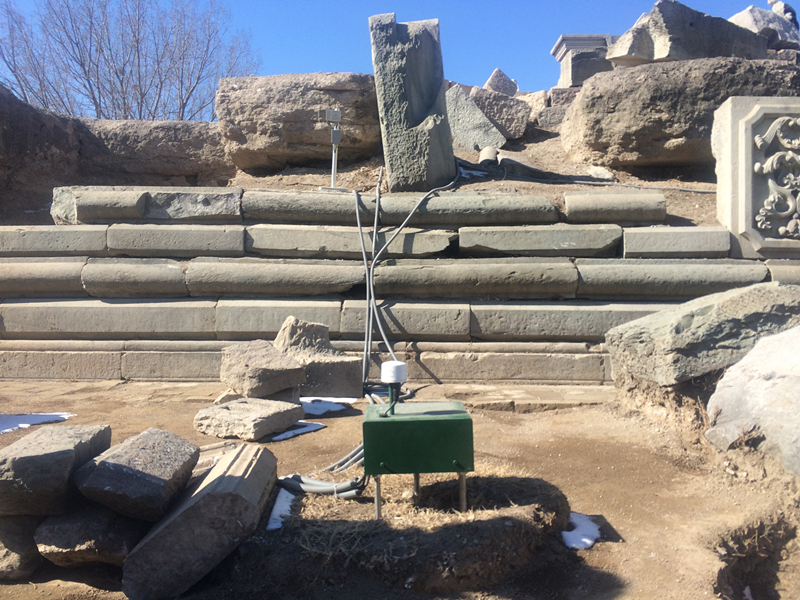
4.1 On-site Instrument Installation at Yuanmingyuan Ruins
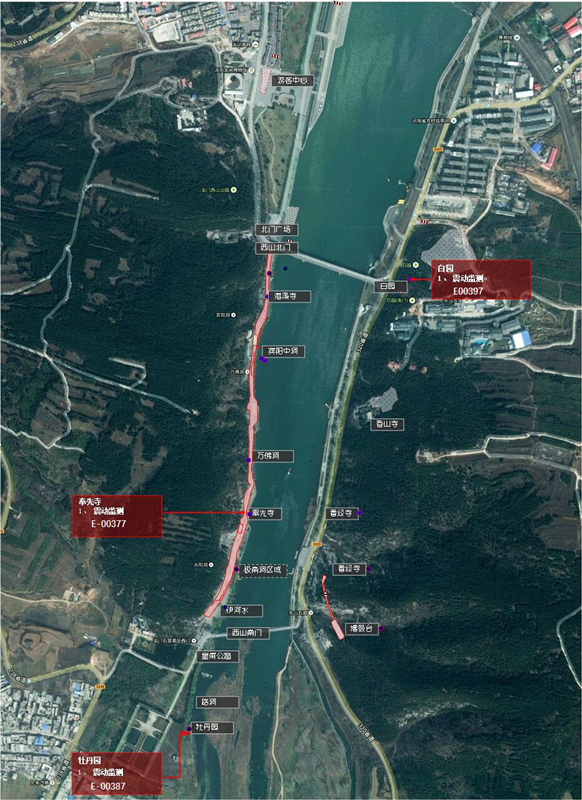
4.2 Monitoring Point Layout Design for Longmen Grottoes